

Health Level 7 (HL7) Fast Healthcare Interoperability Resources (FHIR) is an open standard widely used to exchange health information, using modern internet technology approaches such as RESTful APIs and structured data formats. Through significant efforts by technology developers and the HL7 standards development community, FHIR has reached a level of maturity that makes it ready for widespread adoption. It has been incorporated into the ONC Health IT Certification Program to support key provisions of the 21st Century Cures Act: Interoperability, Information Blocking, and the ONC Health IT Certification Program Final Rule (Cures Act Final Rule). Enacted in 2016 with strong bipartisan support, this legislation has driven the adoption of FHIR-based application programming interfaces (APIs), which now serve as a foundational standard for accessing and exchanging electronic health information across the nation.
FHIR enhances efficiency and interoperability in healthcare by offering a standardized framework for data exchange, which simplifies integration with modern technologies and enables the use of advanced computing capabilities, such as artificial intelligence. By utilizing FHIR-based application programming interfaces (APIs), organizations can reduce technical complexity and ease implementation burden. The FHIR standard offers more granular data specifications leading to a shared foundation for data exchange. Its versatility supports multiple workflows through a unified approach to interoperability. The interoperable exchange of health data facilitated by FHIR minimizes operational challenges and fosters innovation, ultimately supporting more effective healthcare delivery, empowering patients with access to their information, and improving overall patient outcomes.
Federal agencies are uniquely positioned to capitalize on the successes of FHIR and harness its capabilities to realize the full potential of a truly digital health ecosystem. By embracing FHIR and fostering collaboration within the health IT community, agencies can strengthen health data interoperability, enable the development of innovative applications, and drive improvements in health outcomes nationwide.
Aligned with the agency’s mission to develop and oversee implementation of HHS’ strategies and policies for data, technology, interoperability, and artificial intelligence (AI), the Federal FHIR Action Plan informs federal alignment, development, and investment in FHIR specifications. These specifications are essential for clinical care and extend to other healthcare use cases, including public health, research, and policy initiatives.
FEDERAL AGENCY INTERESTS AND HEALTH IT ALIGNMENT ACTIVITIES
Federal agencies, including ONC, CMS, the Centers for Disease Control and Prevention (CDC), the Health Resources and Services Administration (HRSA), and the Department of Veterans Affairs (VA) have played instrumental roles in advancing FHIR as a foundational standard to reduce implementation costs and improve health outcomes. The graphic below depicts federal agency initiatives, regulatory actions, and FHIR development milestones since passage of the Cures Act Final Rule that have led to progress and opportunities available today. These actions culminated in the establishment of FHIR Release 4 (R4) as the current, mature foundational version widely adopted by Certified Health IT developers in the United States. Released in 2018, FHIR R4 has become a stable and reliable standard for federal programs. Until the release of FHIR Release 6 (R6), all new standards development activities and implementations should continue to be based on FHIR R4, at which point the action plan will undergo re-evaluation.
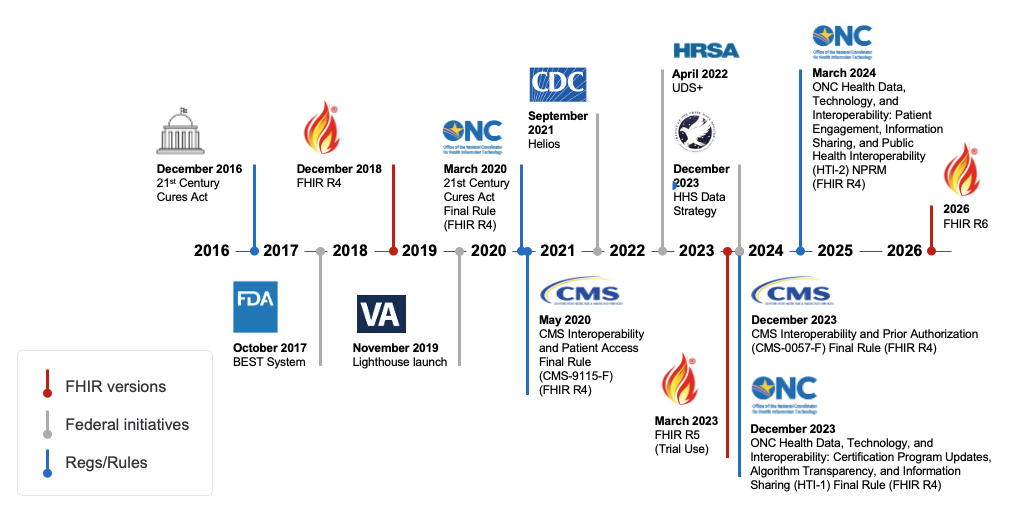
The action plan complements ongoing interagency efforts within the Department of Health and Human Services (HHS) to harmonize data-related initiatives:
- New, mission-critical data elements are structured through ONC's United States Core Data for Interoperability (USCDI) initiative and its extension program, United States Core Data for Interoperability Plus (USCDI+). USCDI is a standardized set of health data classes and constituent data elements for nationwide, interoperable health information exchange. Collaborating with partners such as National Institutes of Health (NIH), the National Cancer Institute (NCI), CMS, CDC, HRSA, the Food and Drug Administration (FDA), VA, and other federal agencies, USCDI and USCDI+ promote greater consistency and semantic interoperability for priority use cases identified by federal agencies, addressing multiple needs across federal programs.
- To further promote and commit to nationwide interoperability, HHS launched the HHS Health IT Alignment Policy in 2023. This policy fosters greater alignment of health IT-related activities and encourages the use of health IT that comply with standards and implementation specifications adopted under section 3004 of the Public Health Service Act.
Coordinated federal involvement in FHIR is vital to ensure the development and implementation of FHIR-based capabilities that address the shared priorities and needs of federal agencies. The action plan marks a major advancement in this effort, using existing federal policies and investments to further promote the adoption and advancement of FHIR and its related technical specifications.