Description (*Please confirm or update this field for the new USCDI version*)
Provider-authored request to another provider, specialist, or organization for care services.
Examples include but are not limited to referral orders to a wound care specialist, housing services, and skilled nursing facility.
Submitted By: Grace Glennon, on behalf of NCQA
/ NCQA
Data Element Information
Data Element Description
Provider-authored request to another provider, specialist, or organization for care services.
Examples include referral orders to a wound specialist or podiatrist.
Use Case Description(s)
Use Case Description
Referral orders represent another important type of order to support care coordination. Not all necessary medical services can be provided by a single provider, making referrals a necessary data point. Like other orders, referral orders are routinely captured and exchanged across care settings for routine care. These orders can be captured and exchanged via standard vocabulary (SNOMED).
In addition to being collected and exchanged as part of routine care for patients, quality measures currently utilize referral order information to assess appropriate care. NCQA continues to add follow-up components to many new and existing measures to assess for appropriate care following a significant medical finding; referral orders are one component to appropriate follow-up.
Estimate the breadth of applicability of the use case(s) for this data element
(Level 2) – Use cases apply to most care settings or specialties.
Referral orders are documented, utilized and exchanged across care settings including primary care, outpatient and acute care settings, and a necessary process step to receive certain types of care.
ONC Priority
Address behavioral health integration with primary care and other physical care
Mitigate health and health care inequities and disparities
Address the needs of underserved communities
Address public health interoperability needs of reporting, investigation, and emergency response
Maturity of Use and Technical Specifications for Data Element
Applicable Standard(s)
SNOMED CT
Additional Specifications
FHIR US Core (6.1.0, 7.0.0) ServiceRequest- must have a code defining what is being requested
Current Use
(Level 2) Captured, stored, or accessed in multiple production EHRs or other HIT modules from more than one developer
Extent of exchange
(Level 2) Between more than two production EHRs or other HIT modules using available interoperability standards
Supporting Artifacts
Referrals are used in quality measures today, and used as part of routine care across almost all provider types.
Potential Challenges
Restrictions on Standardization (e.g. proprietary code)
No restrictions.
Restrictions on Use (e.g. licensing, user fees)
No restrictions.
Privacy and Security Concerns
Exchange of patient health information should follow HIPPA Privacy Rules.
Estimate of Overall Burden
Given that USCDI already includes other orders elements, exchanged via the same structure as this orders element, implementation burden should be low.
Other Implementation Challenges
No other known implementation challenges.
ONC Evaluation Details Each submitted Data Element has been evaluated based on the following criteria. The overall Level classification is a composite of the maturity based on these individual criteria. This information can be used to identify areas that require additional work to raise the overall classification level and consideration for inclusion in future versions of USCDI
Criterion #1 Maturity - Current Standards
Level 2 - Data element is represented by a terminology standard or SDO-balloted technical specification or implementation guide.
Criterion #2 Maturity - Current Use
Level 2 - Data element is captured, stored, or accessed in multiple production EHRs or other HIT modules from more than one developer.
Criterion #3 Maturity - Current Exchange
Level 2 - Data element is electronically exchanged between more than two production EHRs or other HIT modules of different developers using available interoperability standards.
Criterion #4 Use Case(s) - Breadth of Applicability
Level 2 - Use cases apply to most care settings or specialties.
Comment
Submitted byportmi3 on
Commenter: Michael Porter, Mport Media Group, Inc. (Discharge Bridge — care-transition orchestration).
We support USCDI v7 Referral Order, Referral Note, and Reason for Referral for hospital → SNF / post-acute exchange. Please keep SNF / post-acute explicitly in examples and vocabulary guidance.
We support Medication Order and Medication Administration for transition medication safety, and recommend leveling Level 0 Discharge medications (and Medication List Type as applicable) so implementers can exchange a reconciled active list at handoff distinct from open orders vs administration.
We support Encounter Disposition, Appointment, Healthcare Agent, and Discharge Summary Note for operational handoff / decision-maker / disposition context, mapping to these existing elements before inventing new definitions.
We recommend evaluating structured Prior Authorization Determination Status for inclusion or leveling (ONDEC or comment adjacent to Health Insurance Information / related coverage elements), because authorization fragmentation blocks timely acute→post-acute transitions and is relevant under CMS interoperability and prior-authorization directions that reference USCDI. Prefer placement under Health Insurance Information or Orders as ONC prefers — not a new data class.
Prefer mapping operational handoff needs to existing USCDI elements — Encounter Disposition, Discharge Summary Note, Healthcare Agent, Facility Information — and leveling Level 0 Discharge medications — before inventing new definitions.
This comment reflects an implementer perspective. It does not imply ONC endorsement and does not claim HIPAA or SOC 2 certification.
SNOMED International commends ONC for naming SNOMED CT as an applicable vocabulary standard for Referral Orders but we recommend that this be elevated to a required designation. SNOMED CT procedure hierarchy provides a comprehensive, nationally and internationally standardised vocabulary for referral and consultation coding including 307837007 |Referral to person (procedure)| and 306206005 |Referral to service (procedure)| and its descendants which enables consistent, computable referral documentation across care settings. NCQA's HEDIS quality measures already incorporate SNOMED CT-coded referral value sets, demonstrating validated real-world adoption at scale.
Reliance on local or proprietary referral codes which still remain prevalent in EHR implementations, creates barriers to the care coordination interoperability goals of the 21st Century Cures Act and ONC's TEFCA framework. SNOMED CT designation as a required standard for Referral Orders, consistent with its use in CMS Quality Payment Program (QPP) technical specifications, would drive convergence across implementations and eliminate the need for costly mapping between systems.
Recommendation: Add an additional element to USCDI v7 in the Orders data class for Referral Orders, defined as a provider-authored request to another provider, specialist, or organization for care services. Examples include referral orders to a wound specialist or podiatrist. (Vocabulary standards: SNOMED CT)
Rationale: Referral Orders are another important order data element to support care coordination and are already routinely exchanged. Inclusion in USCDI should also facilitate the ability to close the loop on referrals to ensure services requested are carried out, and care is provided, which is the critical step for high-quality, equitable care. NCQA continues to add follow-up components to many new and existing measures to assess for appropriate care following a significant medical finding; referral orders are one component to appropriate follow-up.
The "Optional Background Text / Cover Letter" field provides space for additional context or introductory information related to your comment.
If you wish to provide context, explanation, or an introduction to your comment, enter this information in the field labeled "Optional Background Text / Cover Letter." This is entirely optional and is most useful when submitting multiple related comments or when additional background would help reviewers understand your feedback.
If you are only commenting on a single data class or element, you may leave this field blank.
2. Select the Data Class
To specify which data class your comment addresses:
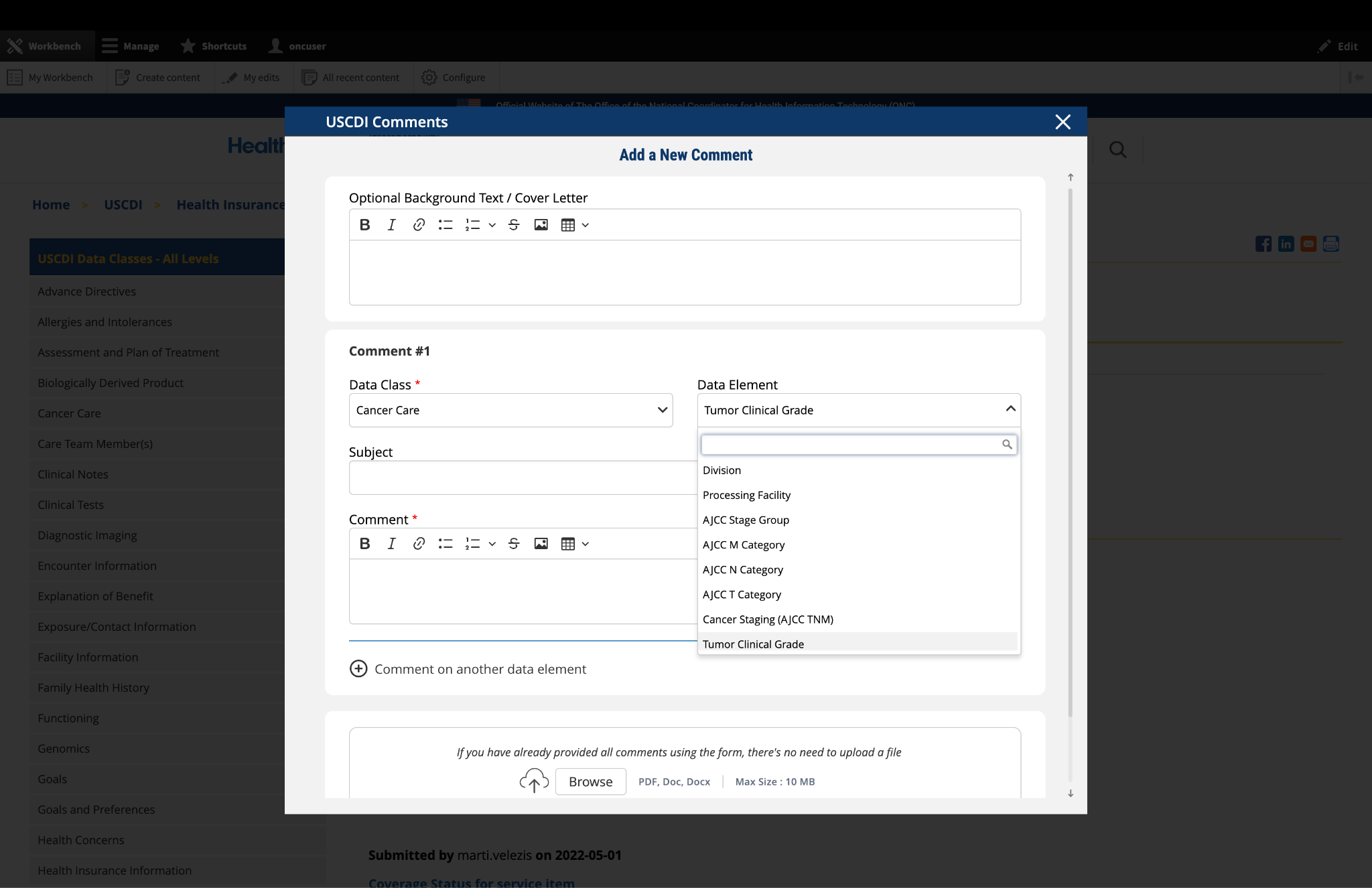
In the "Data Class" drop-down menu, select the appropriate data class you want to comment on.
If you are providing a general comment that is not specific to a data element, select "General" from the options. Comments with this designation will be displayed on the USCDI landing page.
Note that the Data Class field will automatically populate based on your current location in the platform:
If you are on a data class page, the field will be set to that specific data class
If you are on a data element page, the corresponding data class will be pre-selected
3. Select the Data Element
To specify which data element your comment addresses:
In the "Data Element" drop-down menu, select the specific data element you want to comment on.
The drop-down menu will display only the elements available under the data class you selected in the previous step.
You can use the search function within the drop-down to quickly locate a specific data element.
If you are commenting on the data class itself rather than a specific element, you may leave this field blank.
Note: Comments on a specific data element will appear on the respective data element page, while comments on a data class (without a specific element selected) will appear on the landing page for that data class.
Fig 1 The "Data Class" and "Data Element" dropdown menus allow users to specify the exact content they wish to comment on.
4. Optional: Propose New Data Class or Element
If you cannot find the appropriate data class or element for your comment:
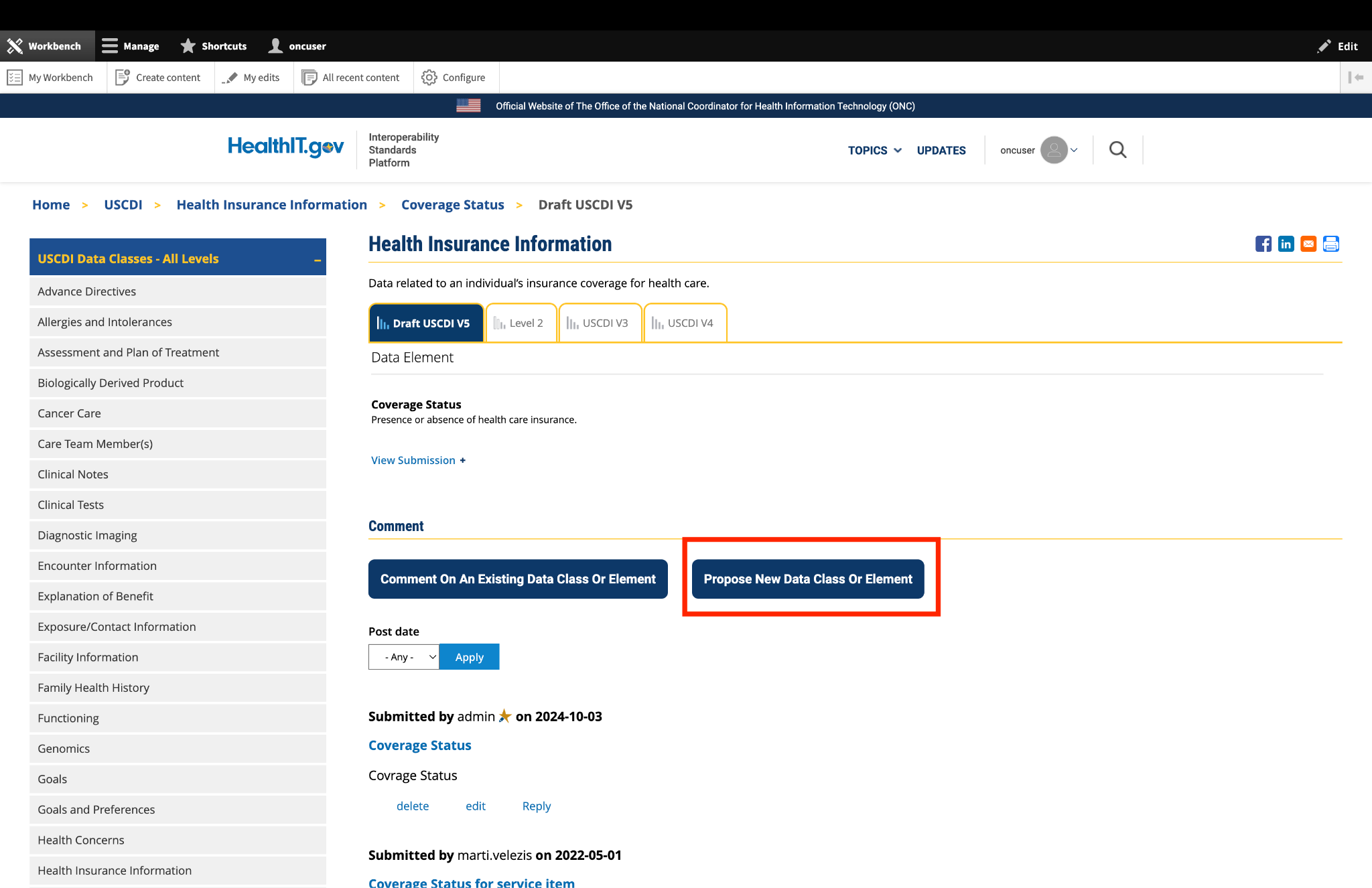
Instead of clicking the "Comment On An Existing Data Class Or Element" button, click the adjacent button labeled "Propose a New Data Class or Data Element."
This will redirect you to the ONDEC (ONC New Data Element and Class) Submission System.
In the ONDEC system, follow the provided instructions to submit your proposal for a new data class or element.
Once your proposal is submitted through ONDEC, it will be reviewed separately from the commenting process.
Fig 2 The "Propose a New Data Class or Data Element" button redirects users to the ONDEC Submission System for proposing new data elements not currently available in the system.
5. Complete the Comment Form
Fill out the required fields in the comment form:
Subject: Enter a brief, descriptive title that summarizes your comment. This helps reviewers quickly understand the nature of your feedback.
Comment: In this field, provide the full details of your comment or feedback. Be as clear and specific as possible about your suggestions, concerns, or observations. Include any relevant details that support your position.
6. Optional: Add Additional Comments
If you need to comment on multiple data classes or elements:
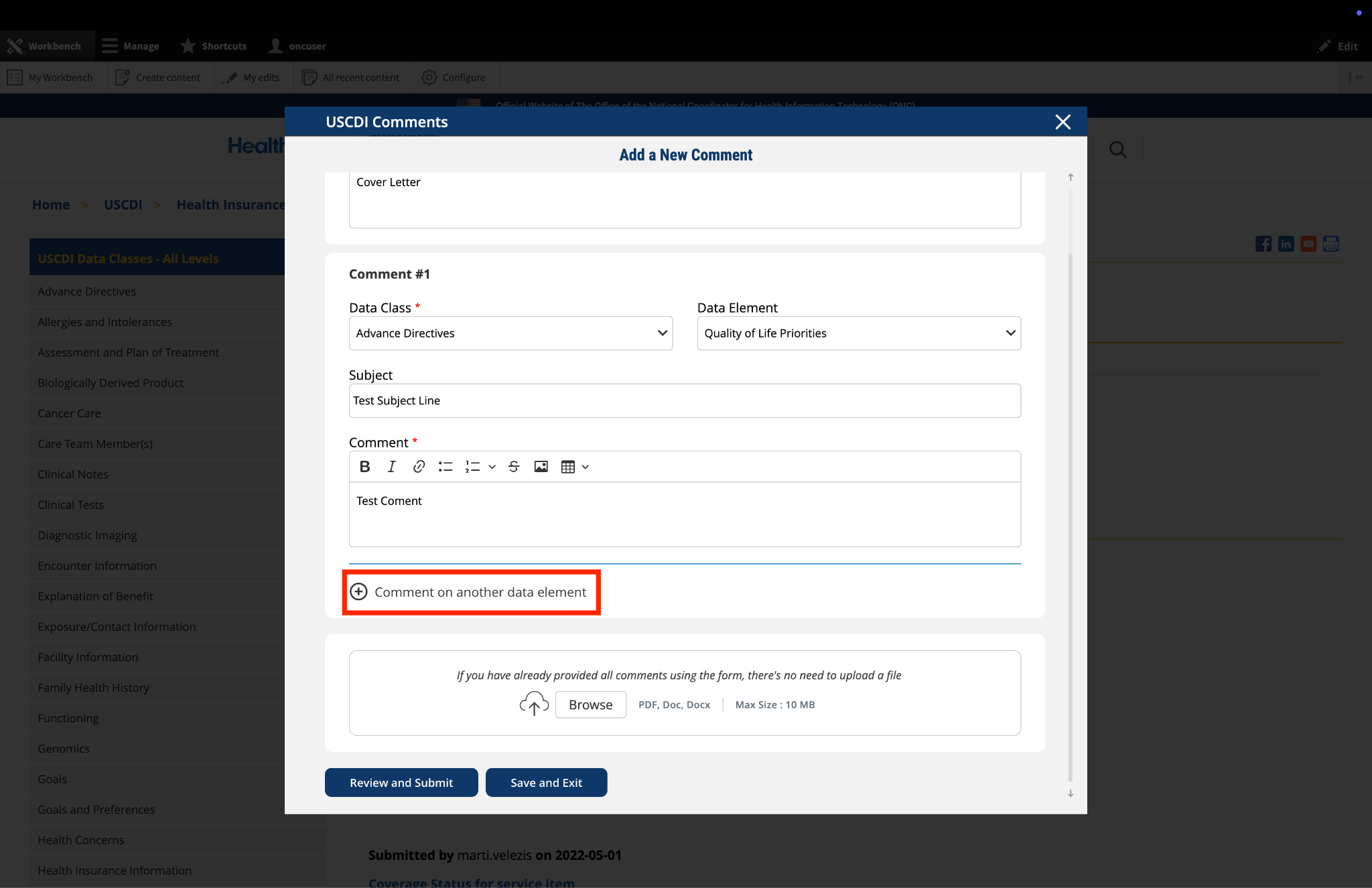
After completing your first comment, click the link labeled "Comment on another data element" at the bottom of the form.
A new comment section will appear, allowing you to enter details for your additional comment.
For each additional comment, you must select the appropriate data class and data element from the drop-down menus.
Complete the Subject and Comment fields for your additional comment.
Repeat this process for each additional comment you wish to submit.
Fig 3 The "Comment on another data element" link enables users to create multiple comments addressing different elements within a single submission.
7. Optional: Upload Supporting Files
The platform allows you to upload supporting documentation to enhance your comment:
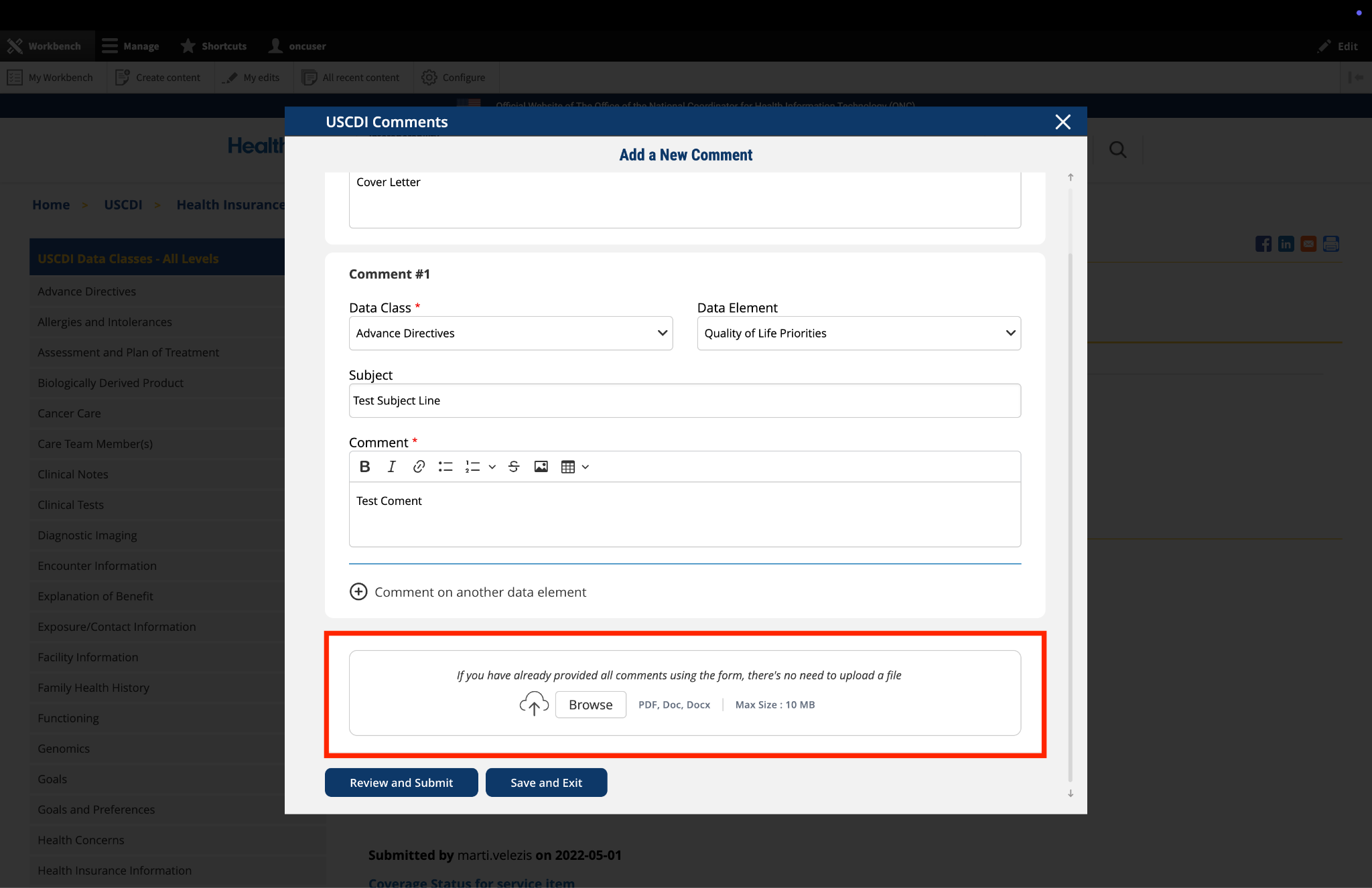
Locate the "File Upload" section at the bottom of the comment form.
Click to upload any files (such as PDFs or documents) that provide additional context, evidence, or clarification for your comment.
Important: If you have already entered your comments using the form fields, there is no need to upload duplicate content in PDF format. The file upload feature is intended for supplementary materials only. Please avoid uploading files that contain the same information already provided in your comment text.
Fig 4 The "File Upload" section permits users to attach supporting documentation that supplements their written comments.
8. Optional: Save and Exit
If you need to pause your work and return to complete your comment later:
Click the "Save and Exit" button at the bottom of the form.
Your comment will be saved as a draft that you can access and complete later.
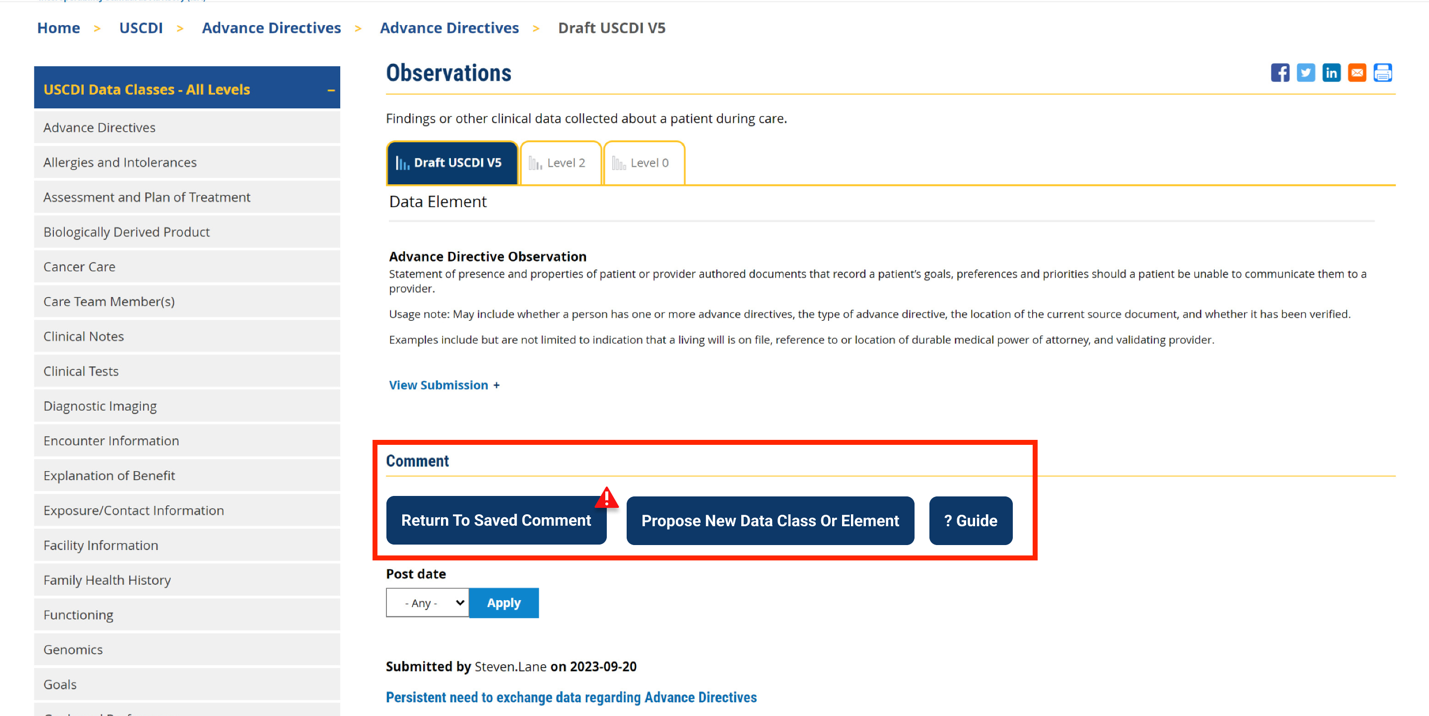
When you return to the platform, you will see a red triangle with an exclamation mark next to the “Return to saved Comment” button, indicating that you have saved comments in draft status.
Click this button to continue working on your draft.
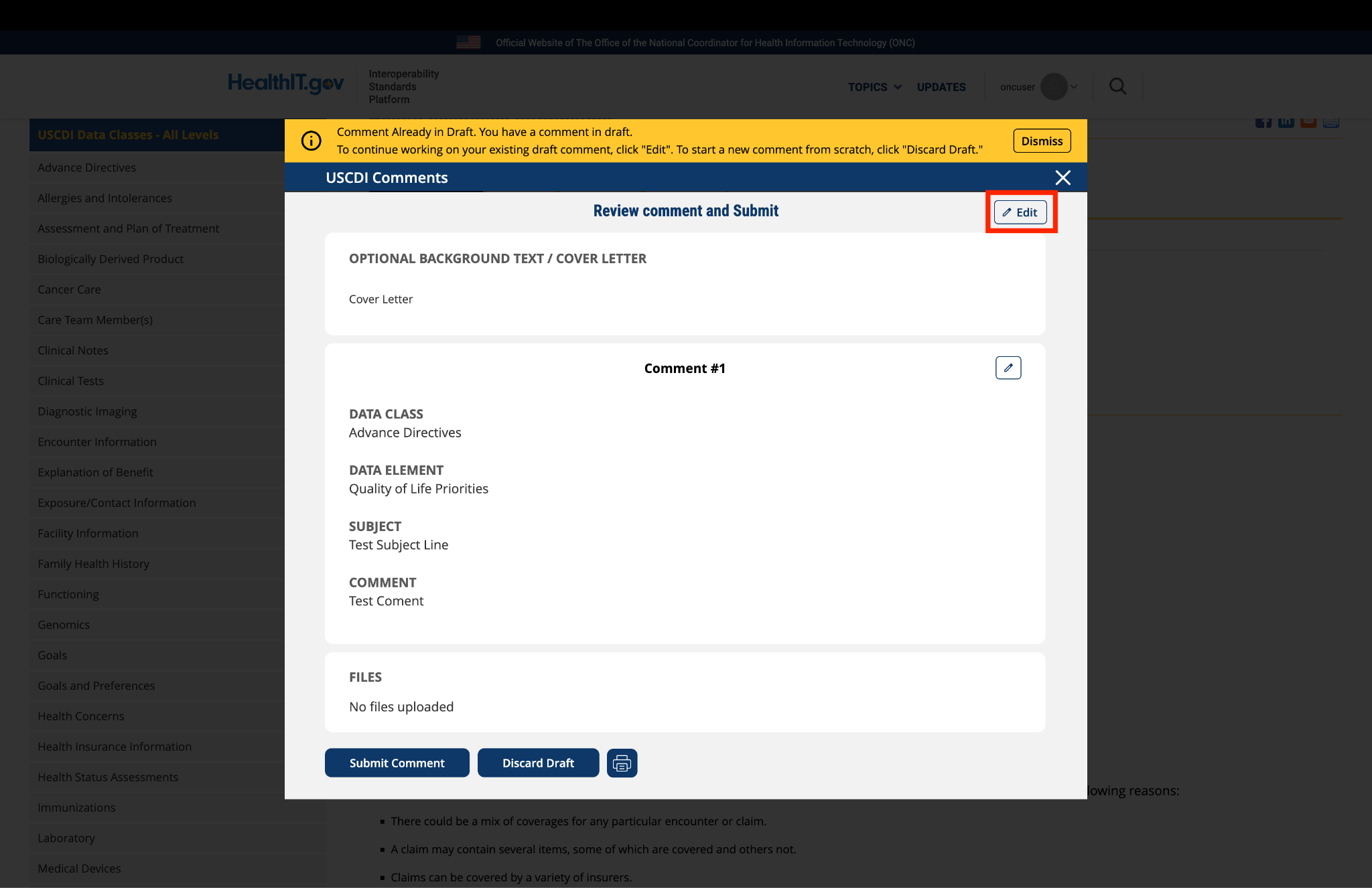
You will be taken to a review page where you can:
Select "Submit Comment" to officially submit your feedback.
Click "Edit" to return to the comment form and make changes
Select "Discard Draft" to delete the saved draft and start fresh
Fig 5 A red triangle with exclamation mark indicator appears next to the “Return to saved Comment” button when draft comments are saved in the system.
9. Review and Submit
Once you have completed your comment:
Click the "Review and Submit" button at the bottom of the form.
This will take you to a review screen displaying your comment(s) in full.
Review all information for accuracy and completeness.
On this review screen, you have three options:
Click "Submit Comment" to officially submit your feedback
Click "Edit" to return to the comment form and make changes
Click "Discard Draft" to delete the comment and start fresh
The review screen also includes a "Print" button that allows you to create a printed copy of your comments for your records.
If you choose to submit, your comment will be recorded in the system and made available for review by the appropriate stakeholders.
Fig 6 The review screen allows users to verify comment content and make any necessary modifications before final submission.


Submitted by portmi3 on
Commenter: Michael Porter, Mport Media Group, Inc. (Discharge Bridge — care-transition orchestration).
We support USCDI v7 Referral Order, Referral Note, and Reason for Referral for hospital → SNF / post-acute exchange. Please keep SNF / post-acute explicitly in examples and vocabulary guidance.
We support Medication Order and Medication Administration for transition medication safety, and recommend leveling Level 0 Discharge medications (and Medication List Type as applicable) so implementers can exchange a reconciled active list at handoff distinct from open orders vs administration.
We support Encounter Disposition, Appointment, Healthcare Agent, and Discharge Summary Note for operational handoff / decision-maker / disposition context, mapping to these existing elements before inventing new definitions.
We recommend evaluating structured Prior Authorization Determination Status for inclusion or leveling (ONDEC or comment adjacent to Health Insurance Information / related coverage elements), because authorization fragmentation blocks timely acute→post-acute transitions and is relevant under CMS interoperability and prior-authorization directions that reference USCDI. Prefer placement under Health Insurance Information or Orders as ONC prefers — not a new data class.
Prefer mapping operational handoff needs to existing USCDI elements — Encounter Disposition, Discharge Summary Note, Healthcare Agent, Facility Information — and leveling Level 0 Discharge medications — before inventing new definitions.
This comment reflects an implementer perspective. It does not imply ONC endorsement and does not claim HIPAA or SOC 2 certification.