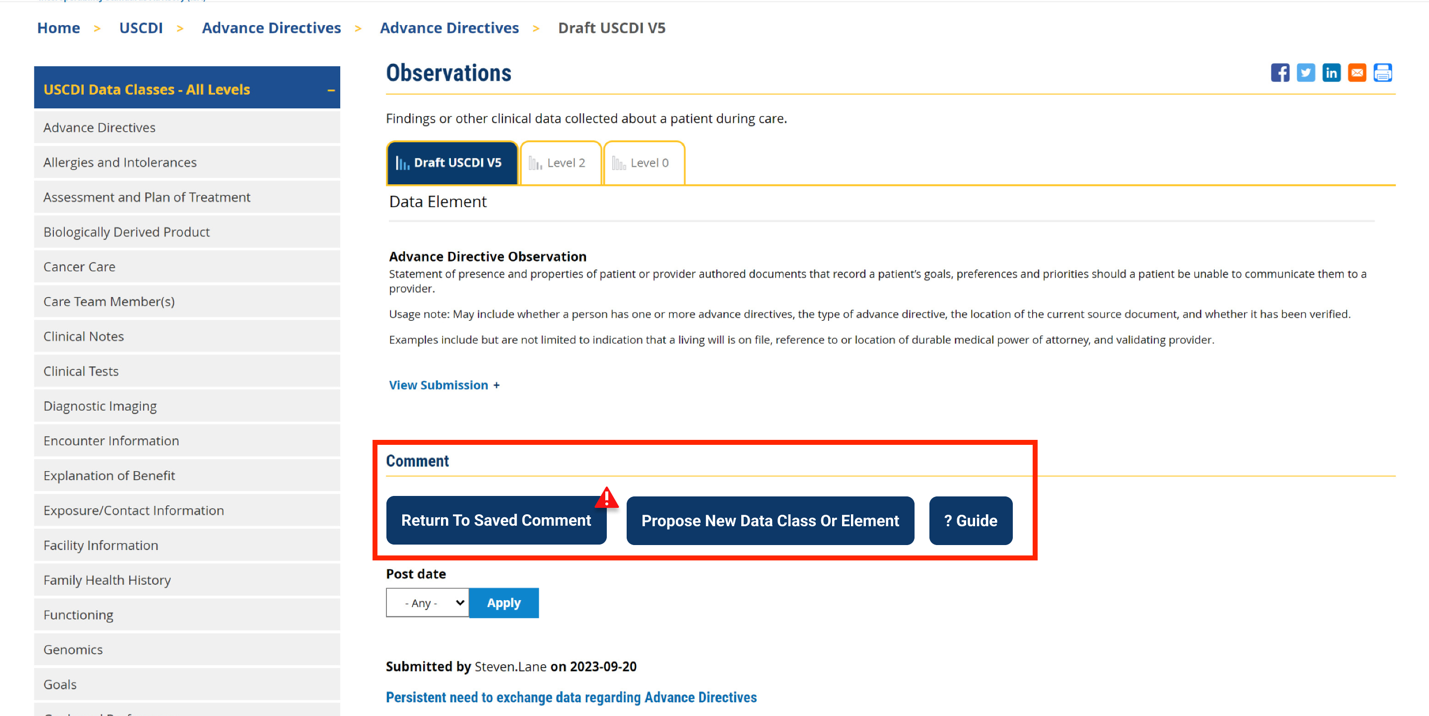
Findings or other clinical data collected about a patient during care.

Data Element

Applicable Vocabulary Standard(s)

Advance Directive Observation

Information about a patient or provider authored document indicating its location, content, type, and verification status.

Usage note: May include structured or unstructured data, whether a person has one or more advance directive documents, the type of advance directive, the location of the document, and whether it has been verified. Such documents may be used should a person be unable to communicate their wishes, preferences, or priorities to their provider.

Examples include but are not limited to an indication that a living will is on file, a reference to the location of durable medical power of attorney, and the validating provider.

Comment

CDC comment on- Observations

CDC recommends that ONC should advance the Observation data class from Level 0 maturity to formal inclusion in USCDI and expand Observation Timing to include Issued Date/Time, representing when the observation result was made available. Rationale: Issued Date/Time provides important context for determining when an observation became available for clinical use. Including it would improve alignment with FHIR/QI-Core and support accurate sequencing of events, clinical decision-making, and quality measurement.

FHIR path)s):
Observation.issued (Simple)

CDC comment on- Observations

CDC recommends that ONC should expand the Observation data class to explicitly include component reference ranges for individual components of an observation. Rationale: Reference range information is important for interpreting individual component results, including whether a result falls within an expected range. Including it would improve alignment with FHIR/QI-Core and support complete and consistent interpretation of multi-component observations for clinical care and quality measurement.

FHIR path(s): Observation.component.referenceRange (Simple)
CDC comment on- Observations

CDC recommends that ONC should expand the Observation data class to explicitly include component interpretation for individual components of an observation. Rationale: Component interpretation provides the interpretation of an individual component result, such as high, low, or abnormal. Including it would improve alignment with FHIR/QI-Core and support accurate interpretation of multi-component observations for clinical care and quality measurement.

FHIR path(s): Observation.component.interpretation (Simple)

Observation class - Surgical Observation (new data element)

New data element in Observation class.

Surgical Observation in used in Oncology (Cancer Related Surgical Procedures) to document lymph nodes, sample nodes, positive nodes and date etc.  Surgical Observation is also used to document additional post-operative or post- procedural observations.

Observations

NACHC agrees that the Observation Data Class must be clarified to contain categories of observations much in the way that SDOH contains multiple data classes and is cross-cutting. We support the comment developed with HL7 below:

Observations (General) - [New Data Class]

https://www.healthit.gov/isa/uscdi-data-class/observations#draft-uscdi-v5

HL7 notes that the distinction between the new Observations data class and other data classes such as Laboratory and Vital Signs, is unclear considering Laboratory Test Results are categorized as Observations, as are Vital Signs.  HL7 suggests that Vital Signs and Laboratory Test Results are included under Observations as references and also as specific data elements that are listed under Observations. This approach would provide greater clarity regarding to which other data classes they would apply.  

PACIO Comments on Advance Directive Observation

  • Data Class: Observations (Currently Draft V5)
  • Data Element: Advance Directive Observation (Currently Level 2)
  • Recommendation: Include the Advance Directive Observation data element in the USCDI V5 under the new Observations Data Class. Clarify that this observation does not supersede the Advance Directive data element.
  • Rationale: The PACIO (Post-Acute Care Interoperability) Project, established February 2019, is a collaborative effort between industry, government, and other stakeholders, with the goal of establishing a framework for the development of FHIR implementation guides to facilitate health information exchange. The PACIO community supports the inclusion of an Advance Directive data element in USCDI. With draft V5 we note that Advance Directive was changed to Advance Directive Observation. We believe that these two data elements do not reflect the same information. An Advance Directive Observation is a finding, such as “code status” or presence of an advance directive document. This is distinct from a data element that captures an advance directive document itself which we support in another comment. Both data elements are needed, but one cannot replace the other as they serve different purposes. We support the inclusion of an Advance Directive Observation data element but do not support it replacing the Advance Directive data element.

Observations more generally

We believe it would be beneficial to include all available observation data in USCDI (within valid privacy constraints, should any exist). There are many types of useful observations beyond vital signs, advance directive information (if correctly classified as an observation), and sex for clinical use that are available, useful, and should be a regular part of clinical data exchange. Having to enumerate and consider each one independently for inclusion in USCDI seems burdensome, slow, and against the idea that sharing clinical data among all relevant parties with a right to see it is good/the goal of this interoperability journey we're all on.

USCDI V5 Feedback

Advance Directive Observation - A single observation made by a person or provider about an Advance Directive Document or Provider-authored Medical Order form or the care experience preferences, treatment intervention preferences, personal healthcare goals, or orders contained within an Advance Healthcare Directive document/form, or an assertion made by a provider about a patient’s advance directive status, such as DNR Status.

The Advance Directive Observation data element is an observation about a person’s available advance healthcare directive information which is expressed in the form of a document. The document is a very important aspect of this data element’s nature because this data element requires “context” to be accurately understood and used. See prior comments about the need to include the Advance Directives data class and advance directive data element in USCDI v5.

Clarify this observation is recording the act of reading/verifying the existence of an advance healthcare directive document or form and identifying the content in the document considered relevant to the course of care for the patient.

APHL Comments on ISA 2022

APHL suggests that USCDI contain some clarification on how this class is expected to be used compared to these other classes, that all contain observations.

Clinical Tests

Clinical Test = Observation Code

Clinical Test Result/Report = Observation Value


Diagnostic Imaging   

Diagnostic Imaging Test = Observation Code

Diagnostic Imaging Report = Observation Value


Laboratory  

Tests = Observation Code

Values/Results = Observation Value

Laboratory Test Performed Date = Observation Timing


Vital Signs

This class is slightly different, as it created a single element for the combination of Observation Code Observation Value; so for example: Systolic blood pressure  references as vocabulary Logical Observation Identifiers Names and Codes (LOINC®) version 2.67 to identify its respective Observation Code and The Unified Code of Units for Measure (UCUM), Revision 2.1 to define the units for the Observation Value, since in this case it will be a numeric value

Vizient comments

Vizient recommends adding to USCDI v3 Observation Value; Observation Code; and Observation Performer. These 3 elements combined could be used to detail what kinds of observations took place, what the observations resulted in, and who ended up performing those observations during the visit.

Log in or register to post comments

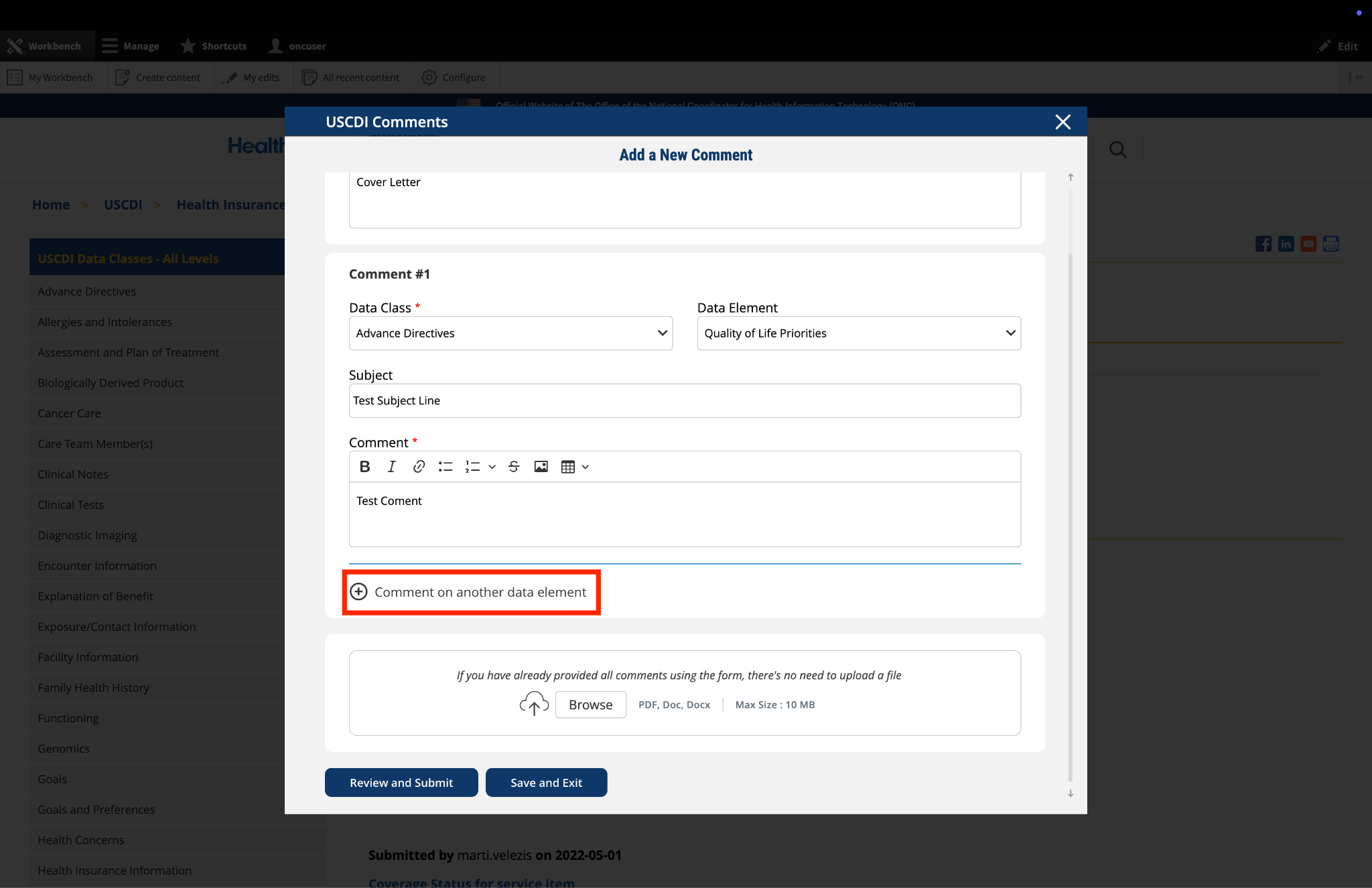
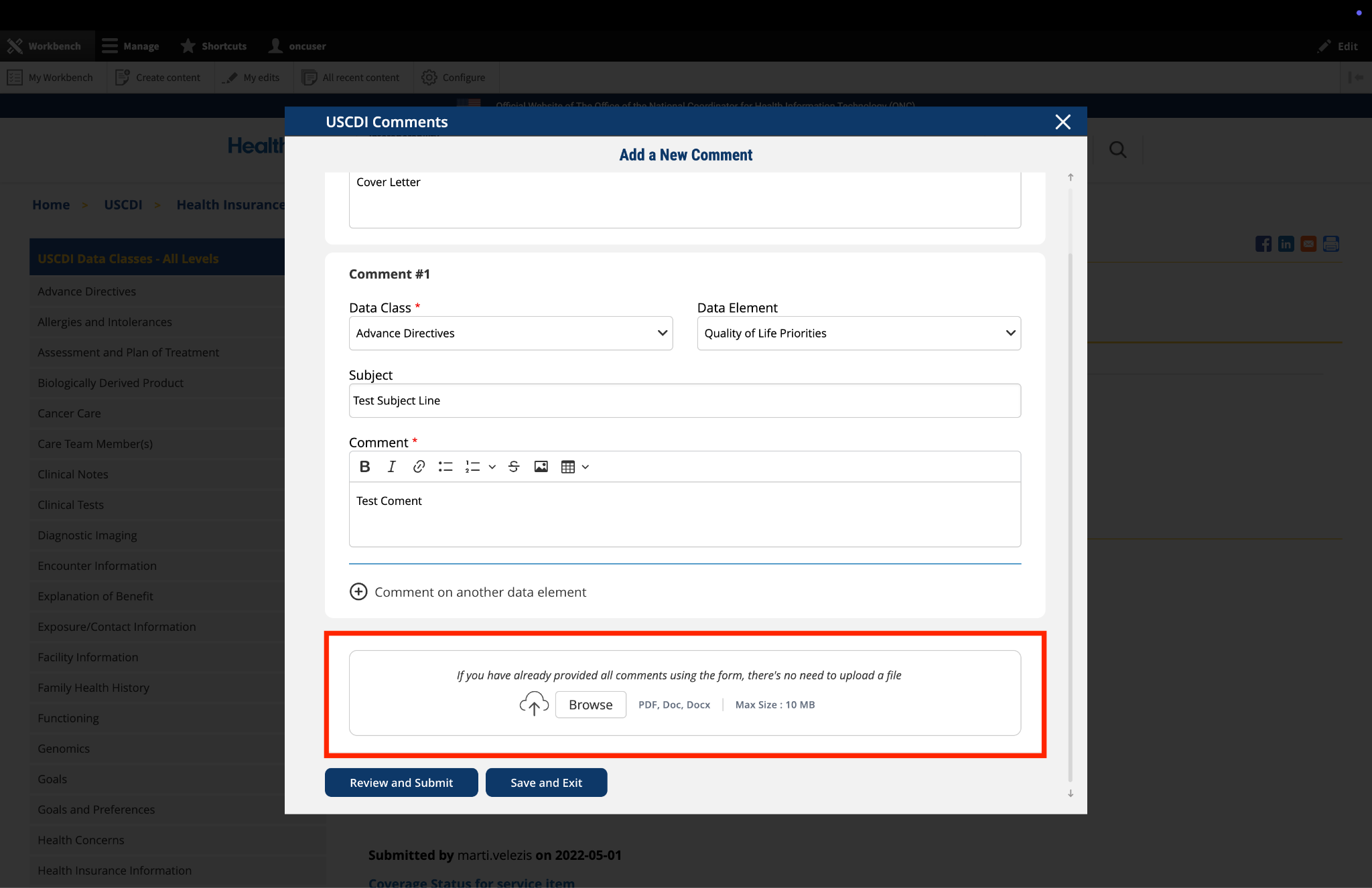
Add a New Comment

Review comment and Submit

Edit
Comment #1
PDF, Doc, Docx
Max Size : 10 MB